How Is the Healthcare Industry Unifying Its Data?
Healthcare has a data unification problem! Here's a technical deep-dive into the current technical and regulatory challenges in fixing this problem.

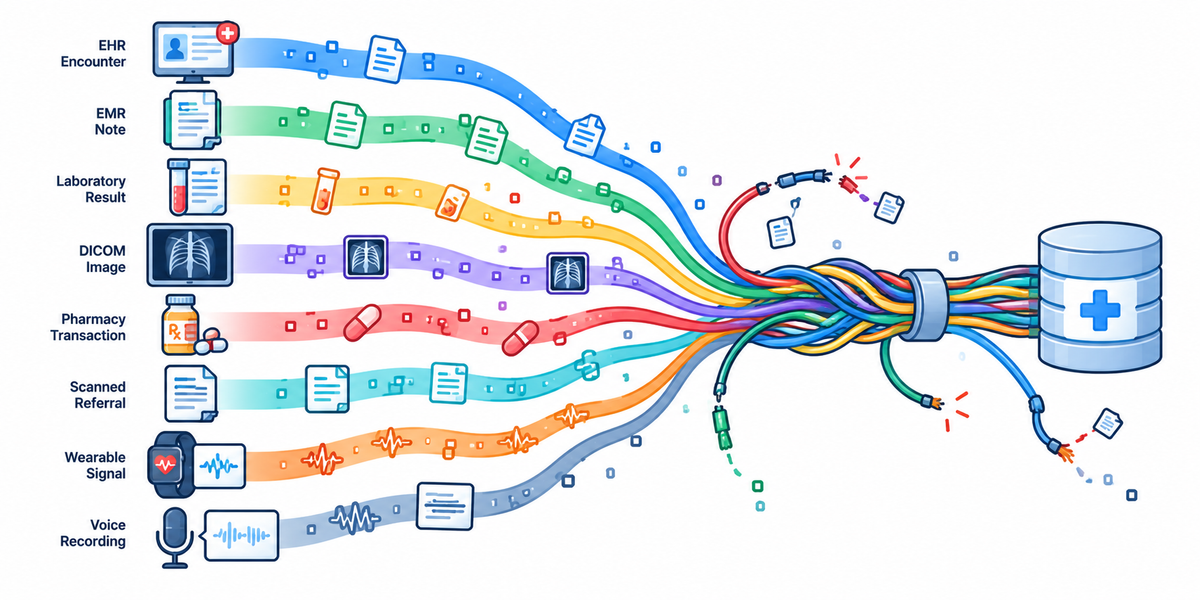
Healthcare has a data unification problem!
Every patient interaction creates another fragment of information: an EHR encounter, an EMR note, a laboratory result, a DICOM image, a pharmacy transaction, a scanned referral, a wearable signal, or a voice recording. The data is everywhere—but it rarely speaks the same language. Different vendors use different schemas, identifiers, APIs, terminologies, and formats, while critical clinical information remains buried inside unstructured documents and free text. As healthcare organizations move aggressively toward AI, this fragmentation becomes more than an interoperability challenge—it becomes an AI infrastructure problem. The question is no longer simply “Can we connect these systems?” but “Can we build a trusted, continuously operating data layer that allows AI to understand the right information, in the right context, at the right time?”
While our previous article explored the regulatory and structural aspects of medical records, this piece focuses on the technical architecture and implementation details.
How it happens?
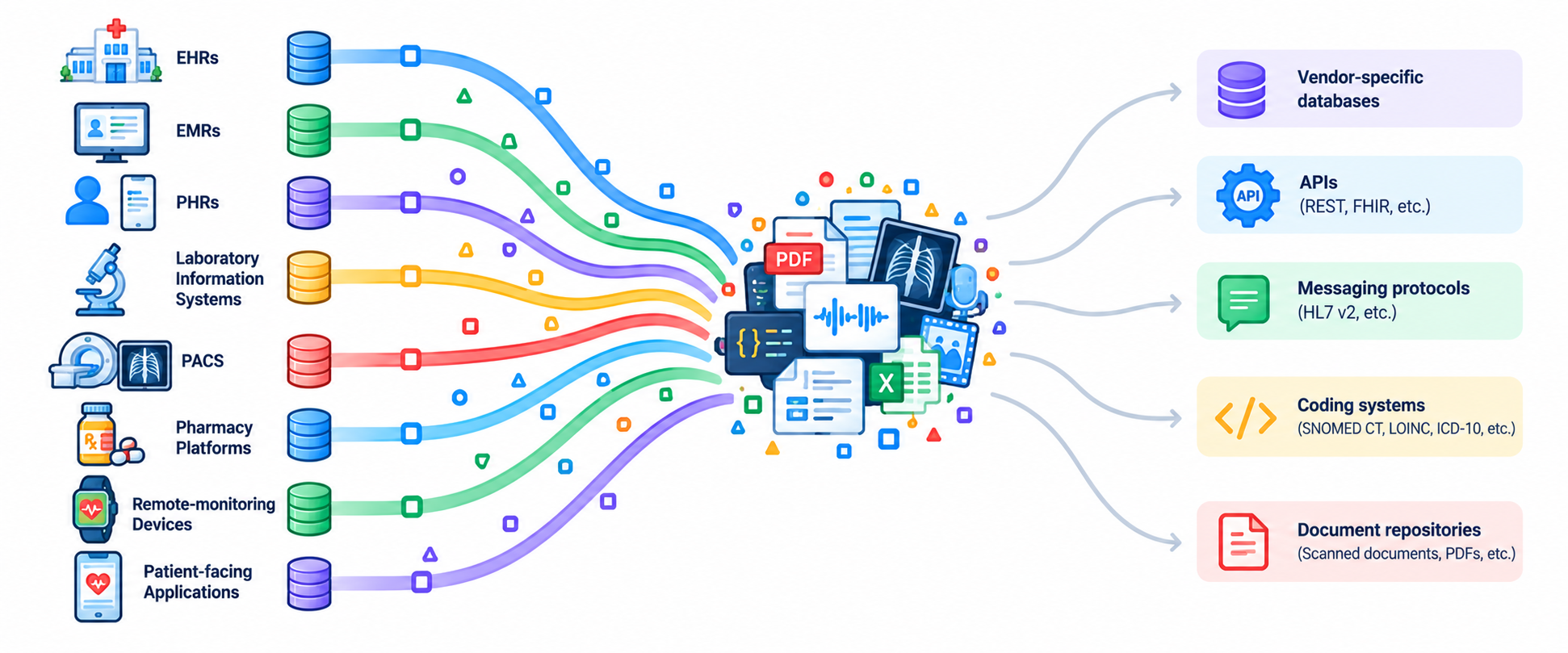
EHRs, EMRs, PHRs, laboratory information systems, PACS, pharmacy platforms, remote-monitoring devices and patient-facing applications collectively generate an enormous volume of healthcare data. The problem is that this information rarely arrives in a single, consistent representation. It is distributed across vendor-specific databases, APIs, messaging protocols, coding systems and document repositories.
A hospital may expose clinical data through HL7 v2 messages and FHIR APIs, while diagnostic imaging is managed through DICOM/PACS, laboratory information may reside in an LIS, and patient-generated information may arrive through mobile APIs or wearable-device platforms. On top of this structured data sits a large unstructured layer: clinical notes, scanned documents, PDFs, faxes, dictated notes, call transcripts and other free-text content.
Healthcare interoperability is therefore not simply a matter of connecting APIs. It is a data harmonization problem.
FHIR has become an important part of the modern interoperability stack because it provides standardized healthcare resources and API-based mechanisms for exchanging clinical and administrative information. The U.S. ONC describes FHIR as an API-focused standard for representing and exchanging health information, while HL7 defines FHIR around reusable resources and RESTful interfaces.
But a FHIR endpoint does not automatically mean that two systems understand the underlying information in the same way.
The convergence starts at the integration layer
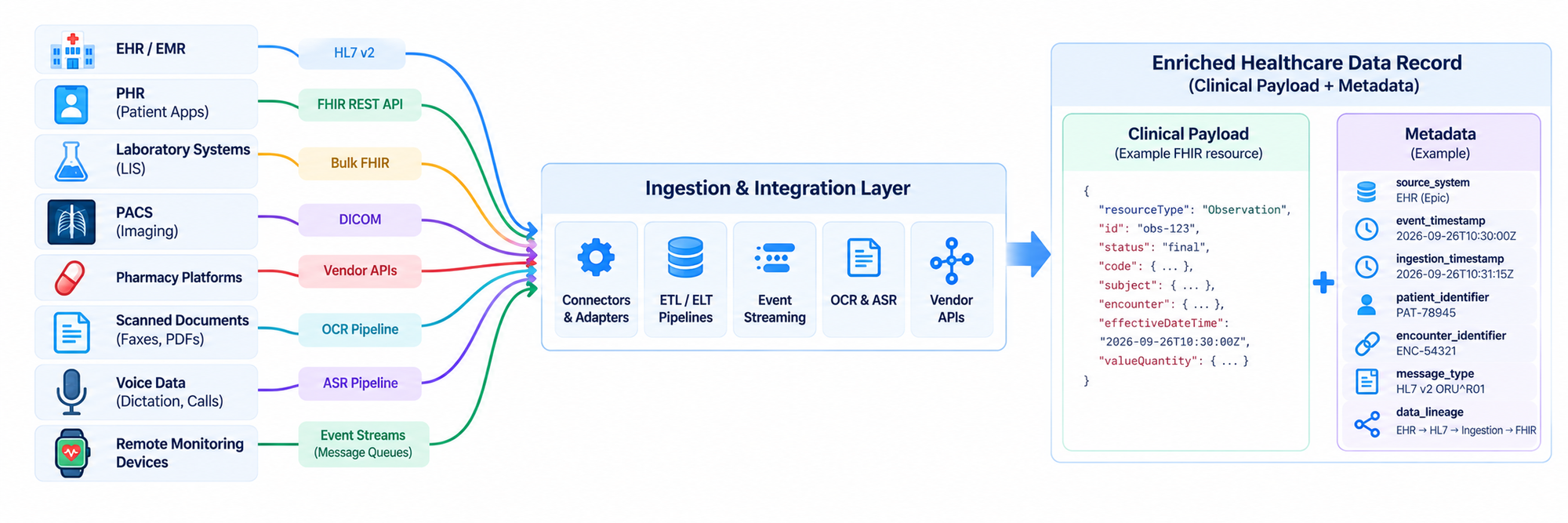
A typical healthcare data architecture begins with an ingestion and integration layer.
This layer may contain:
- HL7 v2 interfaces
- FHIR REST APIs
- Bulk FHIR ingestion
- DICOM interfaces for medical imaging
- Vendor-specific APIs
- ETL/ELT pipelines
- Event streams and message queues
- OCR pipelines for scanned documents
- Automatic speech recognition (ASR) for voice data
The objective is to bring heterogeneous source data into a controlled processing environment without losing its provenance.
For production systems, this often means maintaining metadata such as source system, event timestamp, ingestion timestamp, patient identifier, encounter identifier, message type and data lineage alongside the clinical payload.
That distinction becomes important later when an AI system needs to determine not only what a piece of information says, but where it came from and how current it is.
Standardization is more than changing the data format
Once data has been ingested, the next problem is semantic normalization.
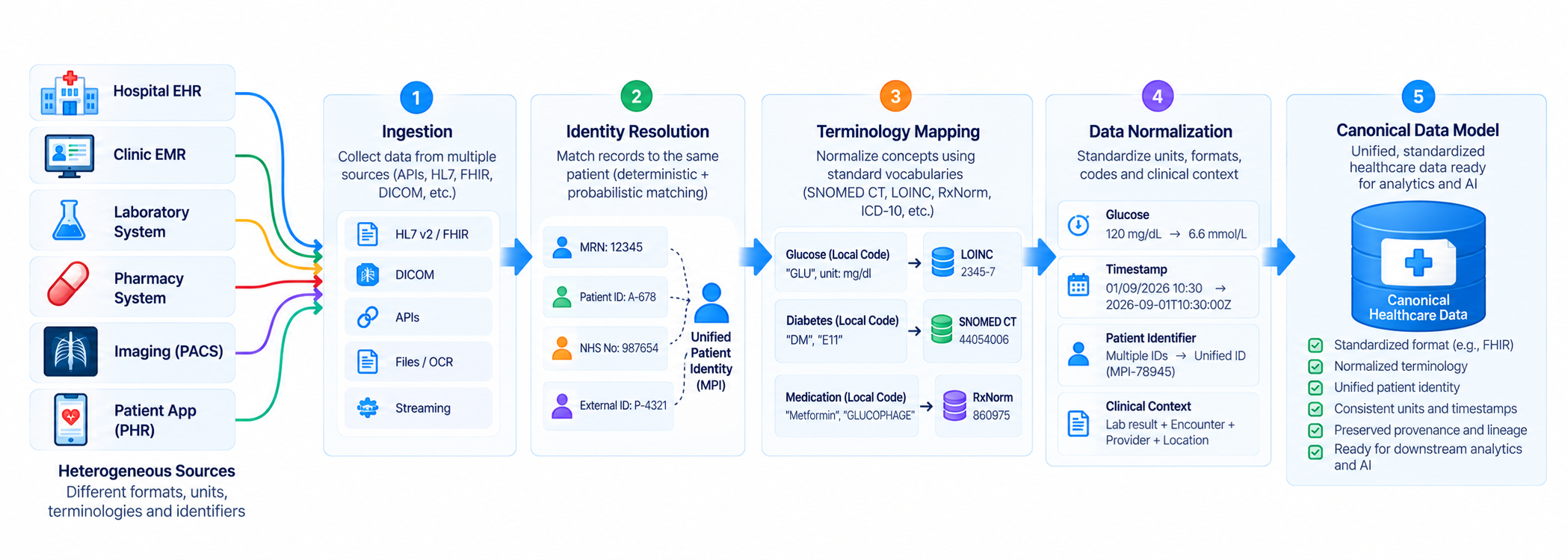
Two systems might both contain a glucose measurement, for example, but represent its unit, terminology, timestamp or clinical context differently.
Healthcare data pipelines therefore commonly use terminology services and mapping layers to normalize concepts across systems. Depending on the domain, this can involve standards and vocabularies such as SNOMED CT, LOINC, RxNorm and ICD-10.
Patient identity is another critical component.
A Master Patient Index (MPI) or equivalent identity-resolution layer can perform deterministic and probabilistic record linkage to determine whether records from different systems refer to the same individual. This is particularly important when identifiers differ between a hospital, clinic, laboratory and patient application.
The pipeline therefore starts to look less like simple ETL and more like:
Ingestion → Identity Resolution → Terminology Mapping → Data Normalization → Canonical Data Model
The resulting dataset is much more useful for downstream analytics and AI.
What happens to unstructured healthcare data?
This is where AI becomes particularly useful.
Traditional integration tooling works relatively well when data is already structured. A database field containing a medication code can be mapped deterministically. A FHIR observation can be validated against a defined schema.
A five-page physician note is different.
A scanned referral may contain a patient's history in free text. A fax may contain an image of a laboratory report. A dictated consultation may exist only as an audio recording.
Healthcare organizations can use OCR, automatic speech recognition, clinical NLP, named-entity recognition (NER), entity linking and document classification to convert these sources into machine-readable information.
For example:
Clinical note → NLP → condition/medication/procedure entities → terminology mapping → structured clinical concepts
A more sophisticated pipeline can additionally use embeddings and vector representations to make clinical documents semantically searchable.
This allows an AI application to retrieve relevant information even when the exact wording differs between the query and the source document.
The emerging AI-ready data layer
Once structured and unstructured information has passed through integration, identity resolution and normalization, organizations can create a canonical healthcare data layer.
FHIR is increasingly important here, particularly for operational interoperability and API-based exchange. ONC's interoperability work also includes the United States Core Data for Interoperability (USCDI), which establishes standardized data classes and elements for electronic health information exchange.
The canonical layer does not necessarily mean that every piece of information must be forced into one database or one format.
A more practical architecture can maintain:
Structured clinical resources + normalized terminology + linked documents + provenance + metadata
This gives downstream AI systems a consistent semantic layer while preserving the original source information.
That distinction is important for AI applications because normalization should not destroy provenance.
An AI system generating a clinical summary should ideally be able to trace relevant information back to the underlying encounter, observation, document or source system.
Where AI enters the architecture
Once the healthcare data has been unified semantically, AI can operate at several levels.
Clinical NLP can extract entities and relationships from notes.
Embeddings can create semantic representations for retrieval.
Retrieval-Augmented Generation (RAG) can retrieve relevant clinical information before an LLM generates a response.
Predictive models can process normalized longitudinal data to identify risk patterns.
Multimodal models can potentially reason across combinations of text, structured measurements and other clinical modalities where appropriate.
And AI agents can sit above these capabilities to coordinate controlled workflows—such as identifying missing documentation, retrieving supporting records, generating a summary and routing a task to the appropriate team.
The important architectural principle is that the AI model should not be responsible for solving every data problem.
AI is most effective when it sits on top of a well-engineered data foundation.
From vendor silos to a common semantic layer
The overall architecture can therefore be thought of as:
Heterogeneous Healthcare Systems
▼
Integration & Ingestion
▼
Identity & Terminology Mapping
▼
Semantic Normalization
▼
Canonical Healthcare Data Layer
▼
AI Foundations & Retrieval
▼
AI Applications & Workflows
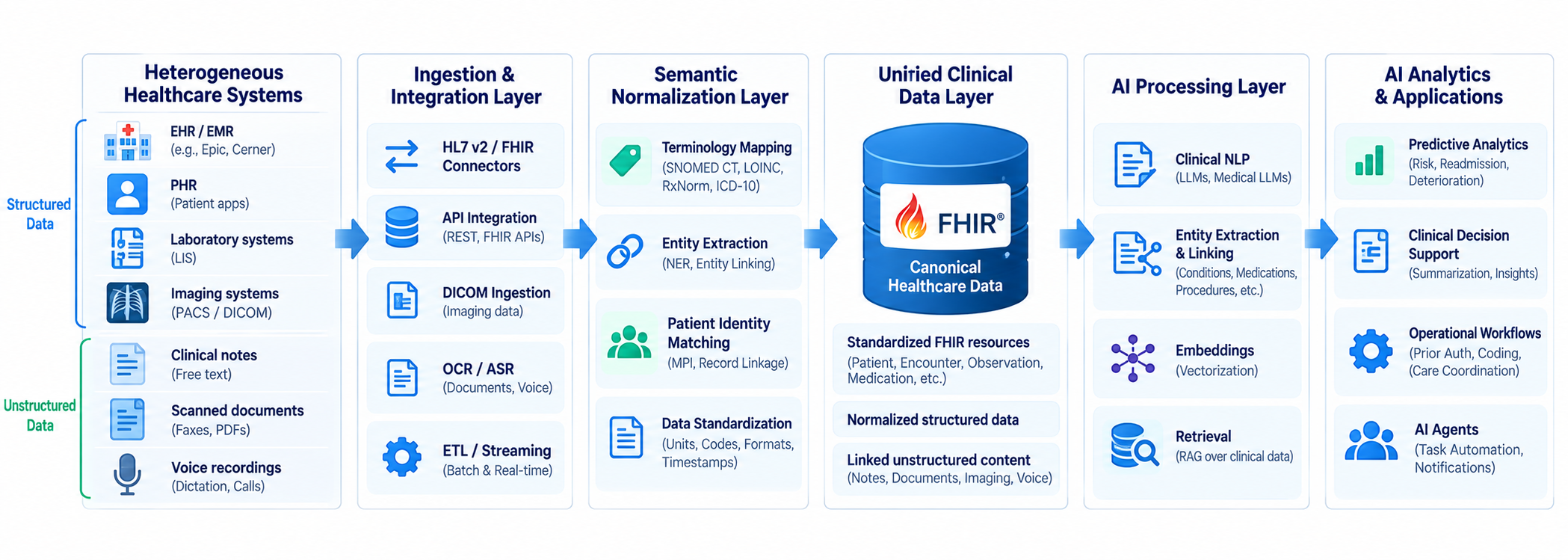
This is fundamentally different from simply connecting one EHR to an AI API.
The objective is to create a trusted semantic layer over heterogeneous healthcare data, where information can be exchanged, normalized, queried and interpreted without losing its provenance or context.
For healthcare organizations, that foundation is becoming increasingly important as AI moves from experimental pilots into production systems.
The real challenge is not getting AI to understand healthcare data. It is building the data infrastructure that allows AI to understand the right data, in the right context, with the right provenance.
Introducing AI Ops
Unifying healthcare data is not a one-time integration project, and it certainly does not end when an API starts returning FHIR resources. It is a continuously evolving technical ecosystem involving data pipelines, interoperability layers, identity resolution, terminology services, normalization, observability, security, AI workloads, model behavior, and operational workflows. As these systems become increasingly dependent on AI, healthcare organizations need more than an AI model or a collection of disconnected integration tools—they need a technical partner who can engineer and operate the entire AI data foundation. A strong AIOps partner can help monitor data pipelines, detect failures and anomalies, maintain data quality, observe AI workloads, trace issues back to their source, and ensure that critical healthcare workflows remain reliable as the underlying systems change. Ultimately, the goal is not to build the most sophisticated AI stack. It is to build a healthcare data infrastructure that professionals can trust—one that makes AI useful, keeps operations dependable, and helps healthcare teams serve patients better.
Don't let fragmented data pipelines undermine your AI initiatives. Focused AIOps delivers the continuous observability, security, and operational rigor your healthcare workloads demand.
References
1. Interoperability & Web API Standards
- HL7 FHIR Release 4 (v4.0.1) Specification: Official RESTful API framework, data schema models, and resource definitions for health data exchange.
HL7 FHIR R4 Specification (HL7 International) - HL7 v2.x Messaging Standard: Traditional pipe-delimited, event-driven messaging standard used across legacy clinical and laboratory interfaces.
HL7 Version 2 Product Family (HL7 International) - Bulk Data Access (Flat FHIR) IG: Specification for asynchronous, large-scale clinical dataset extraction using NDJSON over HTTP.
FHIR Bulk Data Access Implementation Guide - ONC USCDI (United States Core Data for Interoperability): Standardized set of health data classes and constituent elements required for nationwide interoperable exchange.
US Core Data for Interoperability Standards (ONC / ASTP)
2. Medical Imaging & Binary Protocol Specifications
- DICOM PS3.18 (DICOMweb™): Web-based RESTful services defining
QIDO-RS(Querying),WADO-RS(Retrieval), andSTOW-RS(Storage) of medical DICOM objects.
DICOM PS3.18: Web Services Specification (NEMA) - IHE Cross-Enterprise Document Sharing for Imaging (XDS-i.b): Architectural profile defining how imaging documents are registered, shared, and managed across enterprise health networks.
IHE Technical Frameworks: XDS-i.b (IHE International)
3. Terminology & Semantic Normalization Systems
- LOINC (Logical Observation Identifiers Names and Codes): Universal identifier standard for health measurements, laboratory orders, and clinical observations.
LOINC Core Specification & User Guide (Regenstrief Institute) - RxNorm Technical Overview & REST API: Standardized nomenclature for clinical drugs, providing Concept Unique Identifiers (CUIs) and inter-vocabulary mapping.
RxNorm Technical Documentation & API Reference (NIH / NLM) - UMLS (Unified Medical Language System) Metathesaurus: Unified relational database linking millions of biomedical concepts across multi-vocabulary sources (ICD-10, CPT, SNOMED, LOINC).
UMLS Metathesaurus Technical Documentation (NIH / NLM)
4. Patient Identity & Entity Resolution Frameworks
- ISO/TS 22220:2011 Health Informatics: International standard defining identification data elements for patient record linkage and Master Patient Index (MPI) deterministic/probabilistic matching algorithms.
ISO/TS 22220: Identification of Subjects of Health Care