How Query Fan-Out Works and How to Optimize Your Brand for AI Citations
The article below distinguishes documented ChatGPT Search behaviour from the broader query fan-out techniques used in AI retrieval systems. It also explains how to turn those techniques into a practical AEO strategy.

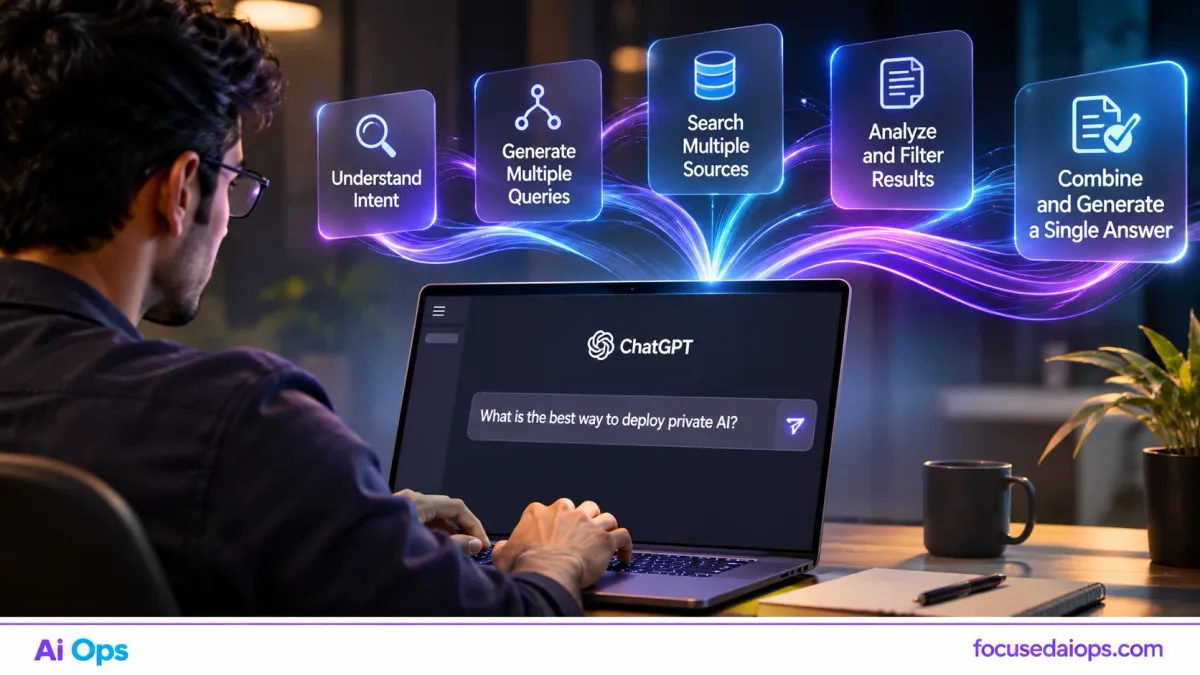
Search has changed!
When someone searches Google for a topic, they usually receive a list of web-pages ranked against their query. They choose which pages to open, compare the information, and form their own conclusion.
AI search systems approach the problem differently. When a user asks a complex question, the system can interpret the intent, generate multiple related search queries, retrieve relevant information, and combine the findings into a single answer.
This process is commonly called query fan-out.
For businesses, it creates a new challenge. Ranking for one keyword may not be enough. Your content needs to answer the related questions an AI search system may investigate before generating its response.
Understanding query fan-out helps businesses build content that AI systems can discover, retrieve, understand, and cite.
What Is Query Fan-Out?
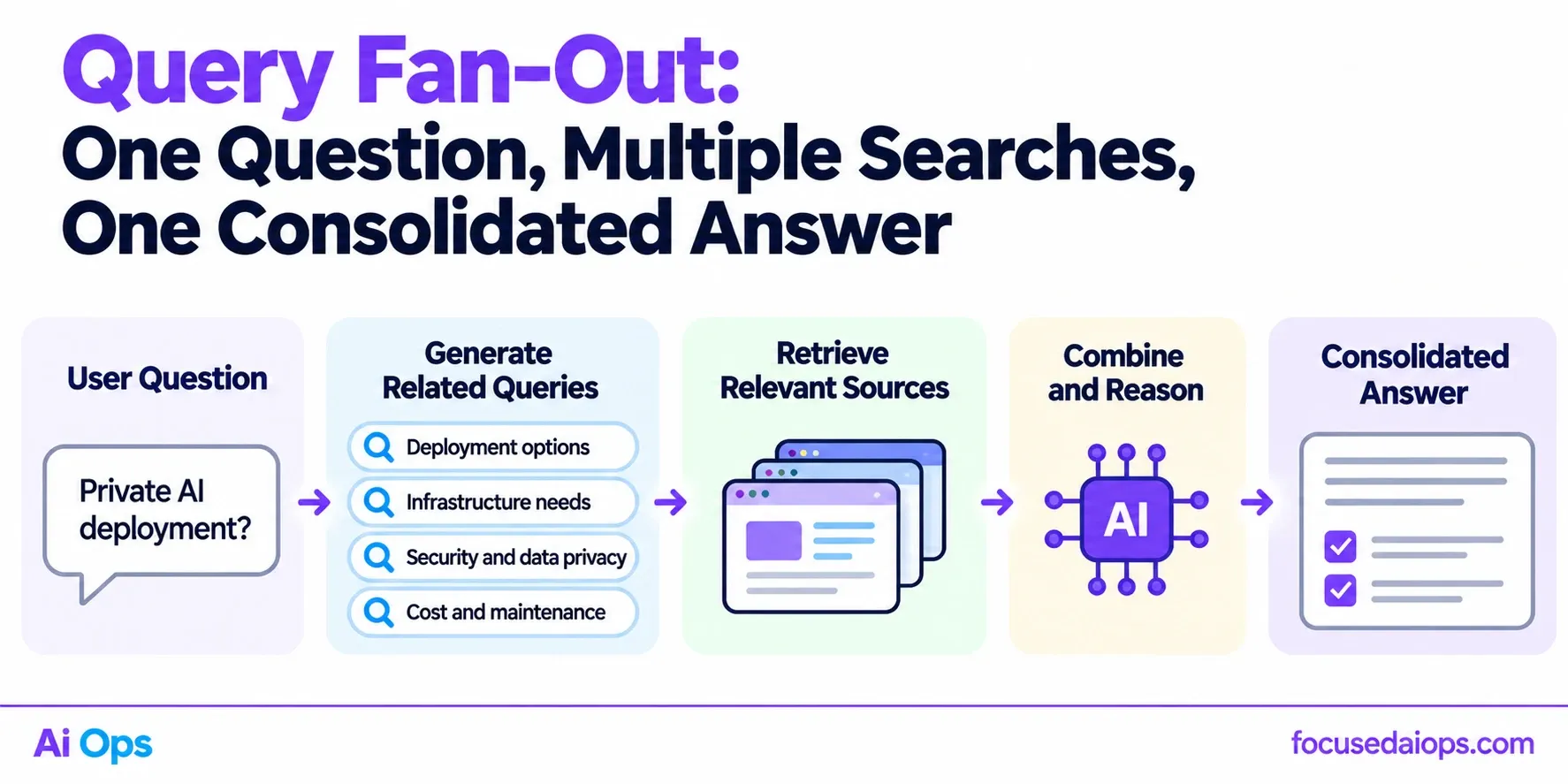
Query fan-out is a search technique that expands one user query into multiple smaller, more specific search queries.
Each expanded query investigates a different aspect of the original question.
Consider someone asking ChatGPT:
"What is the best way to deploy private AI?"
This question is broad. A useful answer may require information about infrastructure, models, security, deployment methods, costs, and maintenance.
A search system may expand the question into queries such as:
- Private AI deployment architecture.
- On-premises LLM deployment.
- Self-hosted LLM hardware requirements.
- Open-source models for enterprise AI.
- Private AI infrastructure costs.
- Enterprise AI data security.
- Private cloud versus on-premises AI.
- RAG architecture for private enterprise data.
These searches investigate different parts of the same subject.
The system can retrieve results from multiple sources, inspect relevant information, and synthesize the findings into a consolidated answer.
The important distinction is that query fan-out is not simply generating synonyms for a keyword. It breaks a broader information need into smaller research tasks.
One question becomes multiple searches. Multiple search results become a consolidated answer.
The exact number of searches depends on the system, query complexity, and available search tools. Not every question triggers extensive research, and there is no guarantee that hundreds of web-pages will be opened.
What Happens When You Type a Question Into ChatGPT?
Let's follow the process using this example:
User query: "What is the best way to deploy private AI?"
Step 1: Understand the user's intent
The language model first interprets what the user wants.
The question contains several possible requirements:
- Understand private AI deployment.
- Identify suitable infrastructure.
- Compare deployment approaches.
- Evaluate security requirements.
- Understand implementation costs.
- Identify practical technology choices.
This is intent analysis.
The system needs to understand the information required to answer the question, rather than relying exclusively on the words used in the original query.
For example, someone asking about private AI deployment may also need information about GPU memory, model quantization, data isolation, and inference servers.
These subjects may not appear in the original sentence, but they are relevant to answering it.
Step 2: Generate multiple search queries
The system can rewrite the original question into targeted queries.
For example:
| Search dimension | Expanded query |
|---|---|
| Architecture | Private AI deployment architecture |
| Infrastructure | On-premises LLM hardware requirements |
| Models | Best open-source LLMs for enterprise |
| Security | Enterprise AI data isolation and security |
| Deployment | Self-hosted LLM deployment methods |
| Costs | Private AI infrastructure cost estimation |
| Knowledge systems | Enterprise RAG implementation architecture |
Each query explores a different dimension.
OpenAI documents that ChatGPT Search can rewrite a user's question into one or more targeted queries and may issue additional, more specific searches after reviewing initial results. The search system can also use general location information when location affects the answer.
This is important because the search process can evolve as the system discovers new information. The initial query does not always define the entire research process.
Step 3: Retrieve relevant web-pages
The search provider returns candidate results for the expanded queries.
These results may include:
- Official technical documentation.
- Research papers.
- Engineering blogs.
- Vendor documentation.
- Industry publications.
- Product comparisons.
- Implementation guides.
- Community discussions.
For example, a search for self-hosted LLM deployment may return documentation about vLLM, Ollama, Kubernetes, GPU infrastructure, and open-source models.
The system does not necessarily open every result.
It selects relevant sources based on factors such as query relevance, source availability, and search ranking.
This distinction matters. Receiving hundreds of search results does not mean the system reads hundreds of complete web-pages.
Step 4: Inspect and filter the information
The system may open selected pages to examine their content.
It can identify:
- Technical specifications.
- Implementation requirements.
- Supported configurations.
- Limitations.
- Cost considerations.
- Security recommendations.
- Relevant examples.
It must also deal with conflicting information.
For example: One source may recommend on-premises deployment for organizations with strict data residency requirements. Another may recommend private cloud infrastructure because it reduces hardware management.
Both approaches can be valid.
The final answer should explain the conditions under which each approach makes sense.
Retrieval quality matters here. Outdated documentation, duplicated articles, promotional claims, and irrelevant pages can reduce answer quality.
Step 5: Synthesize the findings
The model combines relevant findings into a structured response.
For example:
| Finding | Consolidated interpretation |
|---|---|
| On-premises infrastructure provides direct control over hardware and networking | Useful when infrastructure control and internal data boundaries are strict requirements |
| Private cloud reduces hardware ownership | Useful when organizations need flexible infrastructure without operating physical servers |
| Open-source models offer deployment flexibility | Model selection still depends on quality, licensing, hardware, and support |
| RAG connects models to enterprise knowledge | Requires reliable retrieval, access controls, and data governance |
| GPU infrastructure affects inference performance and cost | Workload sizing must precede hardware procurement |
The final answer can combine these findings into a recommendation.
It may include citations to the sources used, allowing users to inspect the original information.
The language model is not simply copying paragraphs from web-pages. It generates a response based on the retrieved evidence and its own learned capabilities.
It can still misunderstand sources, miss relevant information, or produce incorrect conclusions. Citations help users verify claims; they do not guarantee that every claim is supported correctly.
How Query Fan-Out Differs From Traditional Search
Traditional search and AI-powered search solve related problems, but their user experiences differ.
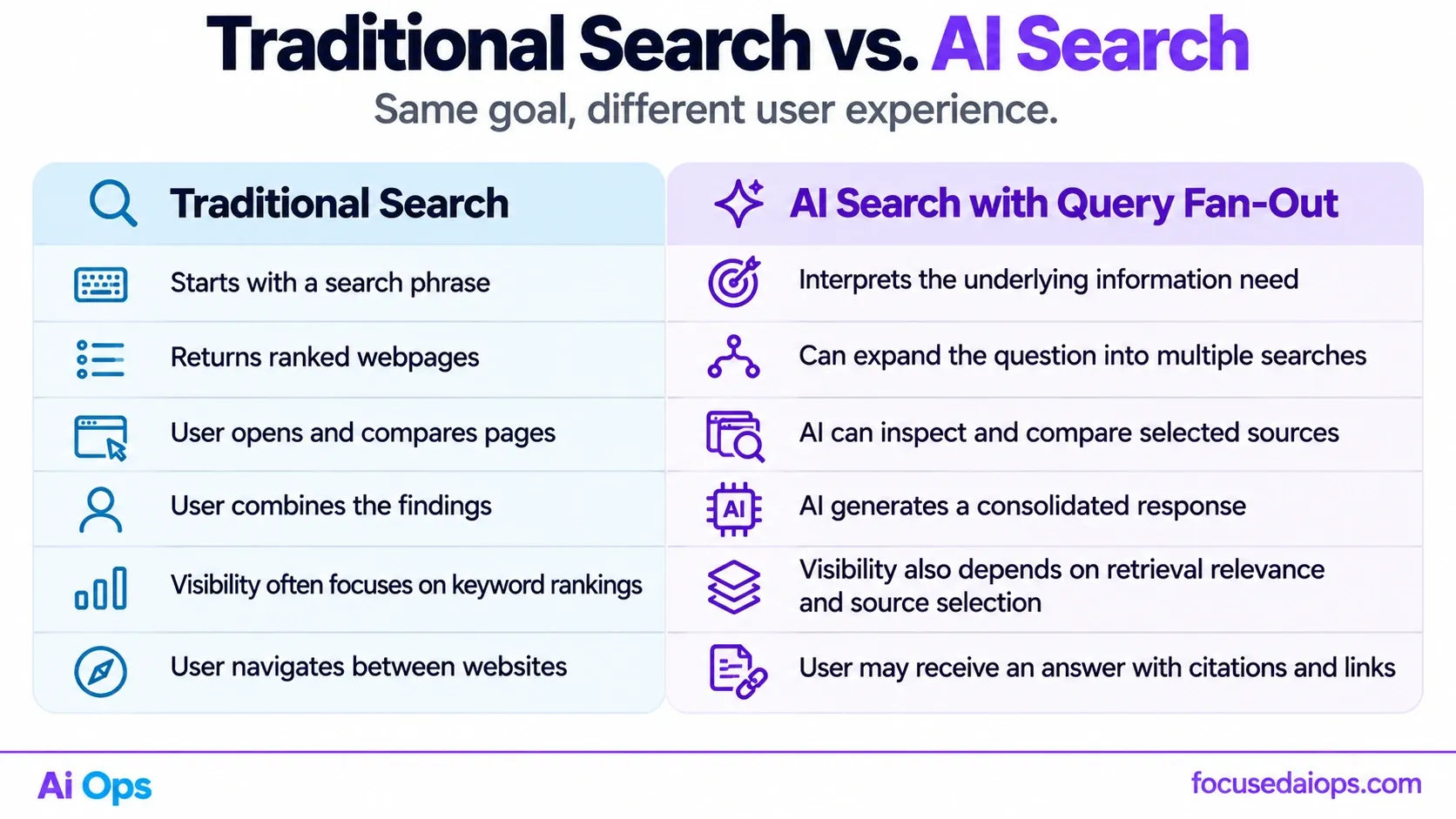
Traditional search remains important. Search engines still provide much of the discovery infrastructure used across the web.
AI search changes what happens after discovery. Instead of requiring users to inspect every result themselves, it can perform part of that research and present the findings in a single response.
This changes how businesses should structure their online content.
Why Query Fan-Out Changes SEO and AEO
Answer Engine Optimization (AEO) is the practice of making website content easier for AI-powered answer systems to discover, understand, retrieve, and use.
Traditional SEO often starts with a target keyword.
For example:
Private AI deployment
An AEO strategy starts with the broader information need behind that keyword.
Someone researching private AI deployment may also ask:
- What is private AI?
- Can an LLM run without internet access?
- Which GPUs are required for local inference?
- How much does private AI deployment cost?
- Is self-hosted AI more secure?
- How does RAG work with private company data?
- Which open-source models support commercial use?
- How do companies monitor private AI infrastructure?
These are related questions, but each represents a different search intent.
If your website only explains what private AI means, it provides limited coverage of the subject.
If it explains the architecture, infrastructure, security, implementation, costs, and operational requirements, it becomes useful across a much broader set of searches.
This is the central AEO opportunity.
Optimize for the subject and its related questions, not just the exact phrase. That's why FAQs tend to do so well for AEO.
Build Content Around Search Intent, Not Keyword Variations
A common SEO mistake is creating separate articles for every keyword variation.
For example:
- What is private AI?
- Private AI explained.
- Private AI meaning.
- Definition of private AI.
- Understanding private AI.
These articles may answer essentially the same question.
They create duplicate coverage without adding meaningful information.
A better approach is to identify distinct information requirements and organize them into a connected content structure.
For the topic of private AI deployment, the structure could look like this:
Main guide: Private AI Deployment
A comprehensive guide covering architecture, deployment models, security, infrastructure, and implementation considerations.
Supporting article 1: Private AI Infrastructure
Cover GPU requirements, memory, inference servers, networking, storage, and scaling.
Supporting article 2: Private AI Security
Explain data isolation, identity management, encryption, access controls, audit logs, and network security.
Supporting article 3: Self-Hosted LLMs
Compare model deployment options, quantization, inference engines, licensing, and hardware compatibility.
Supporting article 4: Enterprise RAG Architecture
Explain document ingestion, chunking, embeddings, vector search, retrieval, ranking, and access control.
Supporting article 5: Private AI Cost Analysis
Compare infrastructure ownership, cloud costs, GPU utilization, maintenance, and operational expenses.
Each article answers a distinct question while contributing to the same subject.
This creates topical depth and gives search systems multiple relevant pages to retrieve.
Build Topical Authority Through Connected Content
Topical authority means demonstrating substantial expertise across the important aspects of a subject.
Publishing one article about a technology does not establish deep expertise.
Consider an organization that wants to be recognized for enterprise RAG architecture.
Its website should cover more than a basic definition.
It should explain:
- Document ingestion pipelines.
- Document parsing and preprocessing.
- Chunking strategies.
- Embedding models.
- Vector databases.
- Hybrid search.
- Metadata filtering.
- Retrieval ranking.
- Context assembly.
- Access control.
- Evaluation and retrieval quality.
- Production monitoring.
Each subject addresses a different technical question.
Connect related articles through descriptive internal links. A reader studying retrieval ranking should be able to find your articles about embeddings, chunking, and evaluation without returning to a search engine.
This structure also helps crawlers discover relationships between pages.
However, topical coverage alone does not guarantee citations. The content must be accurate, useful, accessible, and relevant to the specific query.
Write Content That AI Systems Can Extract and Verify
AI systems need to identify specific information within web-pages.
A page filled with vague statements and promotional language makes this difficult.
Compare these examples.
Weak explanation:
"Our innovative AI solutions empower organizations to unlock next-generation business intelligence through advanced enterprise capabilities."
Stronger explanation:
"Private AI deployment runs language models inside infrastructure controlled by an organization. The infrastructure can be hosted on-premises or in a private cloud. The organization controls model access, data movement, network policies, and deployment configurations."
The second explanation provides concrete information.
Use the following writing structure for technical articles.
Start with a direct definition
Explain the subject in the opening paragraph.
Do not force readers through a long introduction before answering the title's question.
Answer the primary question early
Provide a concise explanation before expanding into technical details.
Use descriptive headings
Headings should identify the actual subject of each section.
For example:
- How Vector Search Works.
- Why Chunk Size Affects Retrieval Quality.
- How RAG Access Controls Work.
Avoid vague headings such as "The Future," "The Next Step," or "Why It Matters" when a more specific heading is possible.
Use comparison tables
Tables make technical differences easier to identify.
For example, compare on-premises deployment, private cloud, and managed AI services using infrastructure ownership, data control, operational responsibility, and cost.
Include implementation details
Explain actual components, configurations, dependencies, limitations, and trade-offs.
A technical article about LangGraph should explain nodes, state, transitions, and check-pointing rather than repeatedly describing the benefits of AI agents.
Cite original sources
Use official documentation and research papers to support technical claims.
When discussing a product feature, link to the product's documentation rather than relying entirely on third-party summaries.
Include original examples
Real implementation details make content more useful.
Explain what happens when a production RAG system retrieves irrelevant documents, how a private inference server handles concurrent requests, or why an agent loses important state during a long-running workflow.
Original technical analysis gives readers information they cannot get from a generic definition.
Structure Your Website for Query Coverage
AEO requires more than publishing individual articles. Your website should make the relationships between its content clear.
Use a pillar-and-cluster structure.
A pillar page covers a broad subject. Supporting articles explain individual components in greater depth.
For example:
| Pillar page | Supporting topics |
|---|---|
| Private AI Infrastructure | GPU sizing, inference servers, deployment models, model hosting |
| Enterprise RAG | Chunking, embeddings, vector databases, hybrid search, retrieval evaluation |
| AI Agent Architecture | LangChain, LangGraph, memory, state management, tool calling |
| AI Security | Data isolation, identity management, prompt injection, audit logging |
| AI Operations | Observability, latency, token usage, cost monitoring, model evaluation |
Follow these rules:
- Give every article a clear purpose.
- Link supporting articles to their relevant pillar.
- Link between supporting articles when the relationship is useful.
- Avoid publishing multiple pages that answer the same question.
- Keep URLs descriptive and stable.
- Update technical articles when products and implementation practices change.
The objective is to build a knowledge structure that both readers and crawlers can navigate.
Technical Requirements for AI Search Visibility
Good content cannot be retrieved if search systems cannot access the website.
Check the following technical requirements.
Allow relevant crawlers
OpenAI identifies OAI-SearchBot as the crawler used to discover content for ChatGPT Search.
Check your robots.txt file and make sure you are not unintentionally blocking it.
Example:
User-agent: OAI-SearchBot
Allow: /
Also check your CDN, firewall, bot-protection rules, and server configuration. A robots.txt permission does not help if your infrastructure blocks the crawler.
OpenAI publishes separate information about its crawlers and their IP ranges.
Keep important content indexable
Check that important pages:
- Return successful HTTP responses.
- Do not contain unintended
noindexdirectives. - Use canonical URLs correctly.
- Are included in your XML sitemap.
- Render their main content in a crawlable format.
- Do not require authentication to access public articles.
Implement structured data
Structured data is machine-readable information embedded in a web-page.
Use appropriate Schema.org types, such as:
OrganizationArticleBlogPostingBreadcrumbListProductService
Only use structured data that accurately represents visible page content.
Schema markup can clarify the meaning of content, but it does not guarantee inclusion in AI-generated answers.
Improve page accessibility
Use semantic HTML, descriptive page titles, meaningful links, and clear heading structures.
Make sure your main article content is available to crawlers even when the website uses JavaScript rendering.
Track crawler activity
Review server and CDN logs for relevant crawler requests.
Monitor:
- Requested URLs.
- HTTP response codes.
- Crawl frequency.
- Blocked requests.
- Redirect chains.
- Server errors.
This helps identify whether important pages are accessible.
How to Measure AI Citation Performance
Traditional SEO metrics do not provide a complete picture of AEO performance.
You should also measure whether AI systems discover and cite your content.
Track these indicators.
| Metric | What it measures |
|---|---|
| AI referral traffic | Visitors arriving from AI platforms |
| AI citations | Frequency with which your pages appear as cited sources |
| Brand mentions | How often AI responses mention your company |
| Query coverage | Whether your content addresses important related questions |
| Page-level referrals | Which articles receive AI-driven visits |
| Assisted conversions | Whether AI-referred visitors become leads |
| Crawler accessibility | Whether relevant search crawlers can access your pages |
Create a repeatable AI visibility test
Build a list of questions that potential customers might ask.
For Focused AiOps, examples include:
- What are the best private AI deployment companies?
- How do enterprises build secure RAG systems?
- How can manufacturers deploy local LLMs?
- What infrastructure is required for self-hosted AI?
- How do companies protect proprietary data when using AI agents?
- How do you monitor private AI infrastructure?
Run these queries periodically across ChatGPT Search and other AI answer platforms.
Record:
- Whether your brand appears.
- Whether your website is cited.
- Which specific pages are referenced.
- Which competitors appear.
- Whether the answer accurately describes your services.
- Whether the cited pages contain information that supports the answer.
Repeat the tests using consistent prompts and dates.
AI answers can change based on location, query wording, available sources, and product updates. Treat individual tests as observations rather than definitive rankings.
Some Common AEO Mistakes
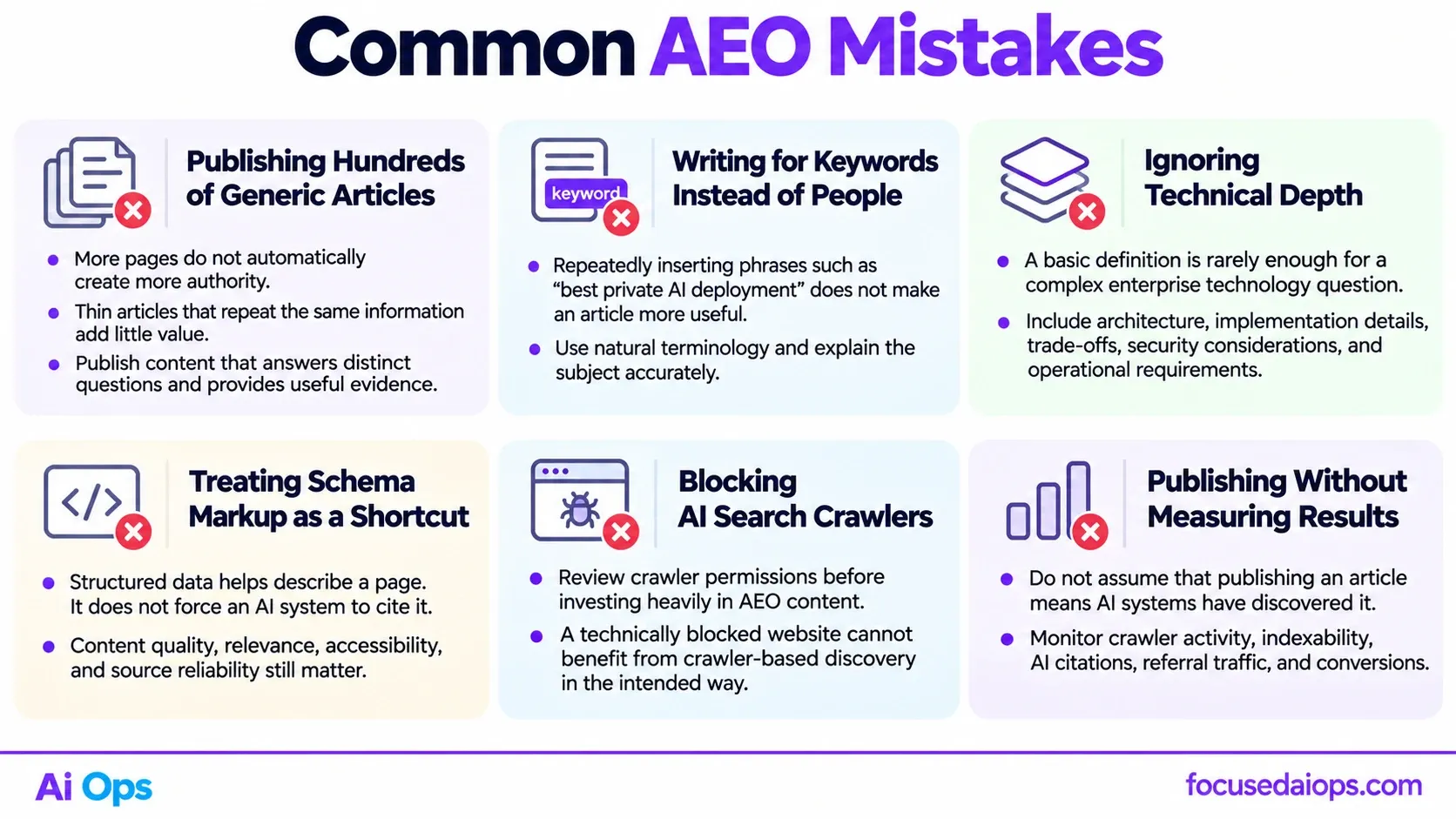
Publishing hundreds of generic articles
- More pages do not automatically create more authority.
- Thin articles that repeat the same information add little value.
- Publish content that answers distinct questions and provides useful evidence.
Writing for keywords instead of people
- Repeatedly inserting phrases such as "best private AI deployment" does not make an article more useful.
- Use natural terminology and explain the subject accurately.
Ignoring technical depth
- A basic definition is rarely enough for a complex enterprise technology question.
- Include architecture, implementation details, trade-offs, security considerations, and operational requirements.
Treating schema markup as a shortcut
- Structured data helps describe a page. It does not force an AI system to cite it.
- Content quality, relevance, accessibility, and source reliability still matter.
Blocking AI search crawlers
- Review crawler permissions before investing heavily in AEO content.
- A technically blocked website cannot benefit from crawler-based discovery in the intended way.
Publishing without measuring results
- Do not assume that publishing an article means AI systems have discovered it.
- Monitor crawler activity, indexability, AI citations, referral traffic, and conversions.
AEO Roadmap for Businesses
A company can start with a focused 90-day program.
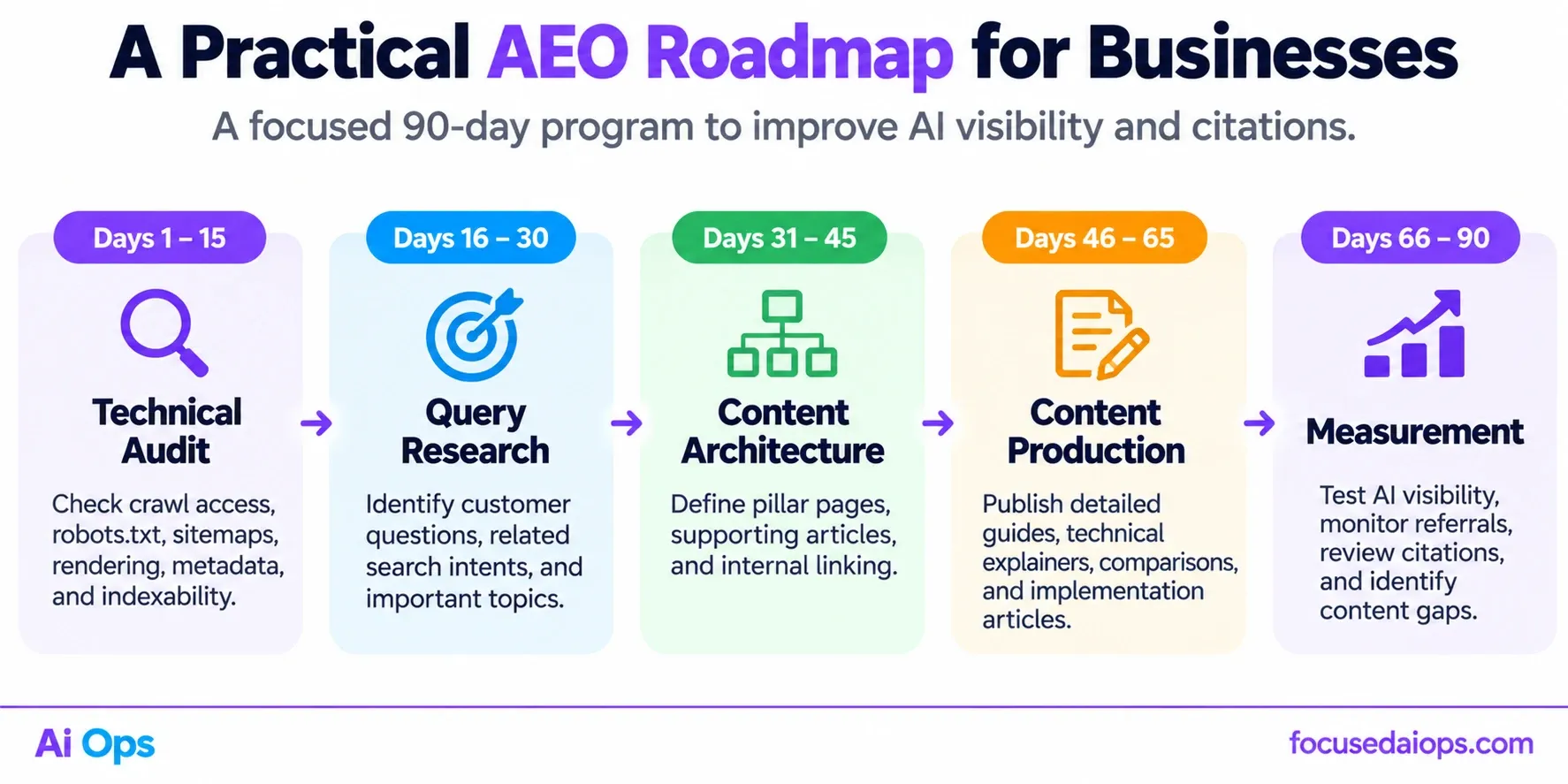
Start with subjects that directly connect to your products and services.
For a private AI infrastructure provider, a detailed guide to secure enterprise RAG may generate more qualified interest than a generic article about the future of artificial intelligence.
Prioritize relevance to your customers over publishing volume.
Conclusion: Build a Knowledge Base That AI Can Trust and Cite
Query fan-out changes how users discover information.
A single question can lead to several targeted searches, multiple retrieved sources, and a consolidated AI-generated answer.
Businesses need to account for this when building their online presence.
A strong AEO strategy covers the questions surrounding a subject, explains technical concepts clearly, connects related articles, cites authoritative sources, and keeps website content accessible to search systems.
The objective is not to appear in every AI answer. It is to become a useful, credible source when an AI system investigates a subject within your area of expertise.
At Focused AiOps, we work on enterprise AI architecture, private AI infrastructure, proprietary data systems, and autonomous workflows. Our work requires technical depth across model deployment, retrieval systems, data governance, and production operations.
We apply the same engineering principles to how technical knowledge is structured and communicated: clear information, verifiable claims, and practical implementation details.
If your organization wants to build private AI capabilities or improve how its technical expertise is discovered across AI-powered search, Focused AiOps can help develop the underlying architecture and strategy.
Own Your Intelligence. Protect Your Advantage.
References and further reading
1. AI Search Architecture & Multi-Query Retrieval
- Introducing ChatGPT Search : OpenAI Engineering & Product Announcements. Official launch documentation breaking down how web search capabilities are integrated into real-time LLM inference loops.
- Searching the Web with ChatGPT - Help Center : OpenAI Technical Support. Overview of how modern chat interfaces automatically identify when queries require live web synthesis and dynamic sub-searches.
- OpenAI Developers - Web Search Tool Integration Guide : OpenAI Platform Documentation. Technical implementation specs detailing how automated search agents execute parallel background queries to pull fact-dense web snippets.
2. Search Engine Optimization & Machine Readability
- Google Search Essentials & SEO Starter Guide : Google Search Central. Foundational guidelines on semantic content hierarchy, crawlability, and clear information architecture for automated crawlers.
- Schema.org Structured Data Vocabulary : Schema.org Community Standard. Standardized semantic markup specifications (
FAQPage,TechArticle,HowTo) that help RAG pipelines extract entity relationships without processing heavy DOM layouts.
3. Answer Engine Optimization (AEO) Frameworks
- OpenAI Academy - Research and Learning Resources - OpenAI Educational Hub. Core concepts behind information retrieval, query decomposition, and context window assembly in frontier models.