How the Healthcare Industry Is Handling EHR, EMR and PHR Data With AI ?
Understanding the data ecosystem in healthcare industry. As organizations have been collecting digital patient information for years, but the volume, variety and complexity of that information continue to grow.

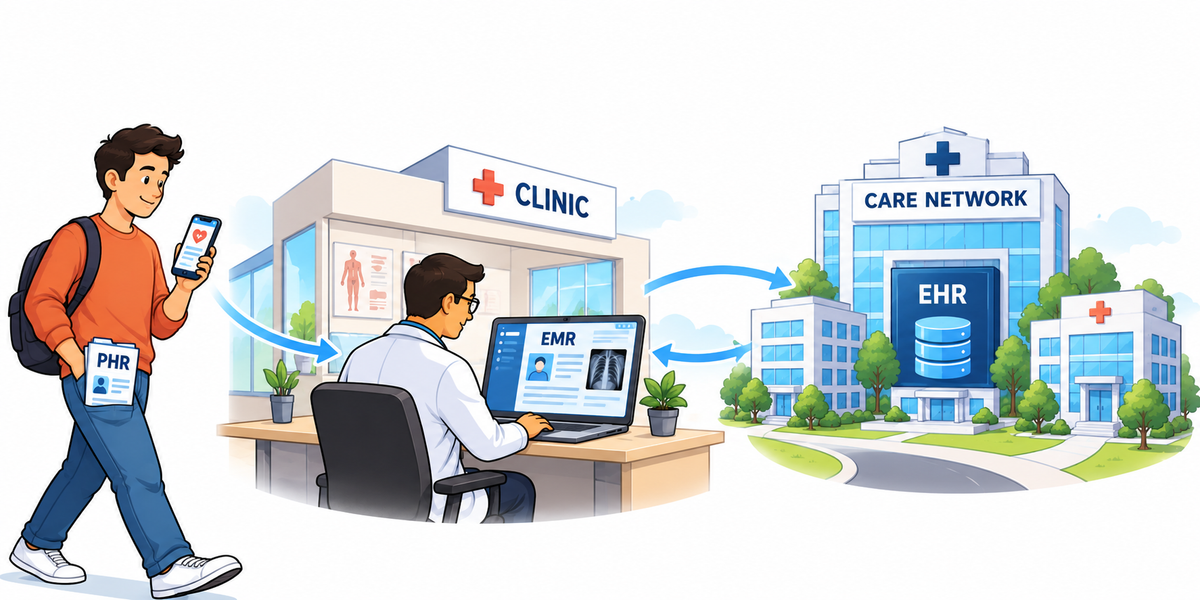
Healthcare organizations have been collecting digital patient information for years, but the volume, variety and complexity of that information continue to grow. Electronic Medical Records (EMRs), Electronic Health Records (EHRs), Personal Health Records (PHRs), laboratory systems, medical devices, wearable technology and healthcare applications are all contributing to a much larger healthcare data ecosystem.
The challenge is no longer simply storing this information. Healthcare organizations increasingly need to connect it, understand it, secure it and turn it into useful intelligence.
This is where artificial intelligence is beginning to play an important role.
But successful healthcare AI is not simply about putting a large language model in front of an EHR. It requires reliable data pipelines, interoperability, data quality, security, monitoring and carefully controlled automation.
EHR, EMR and PHR: Understanding the Three Healthcare Data Ecosystems
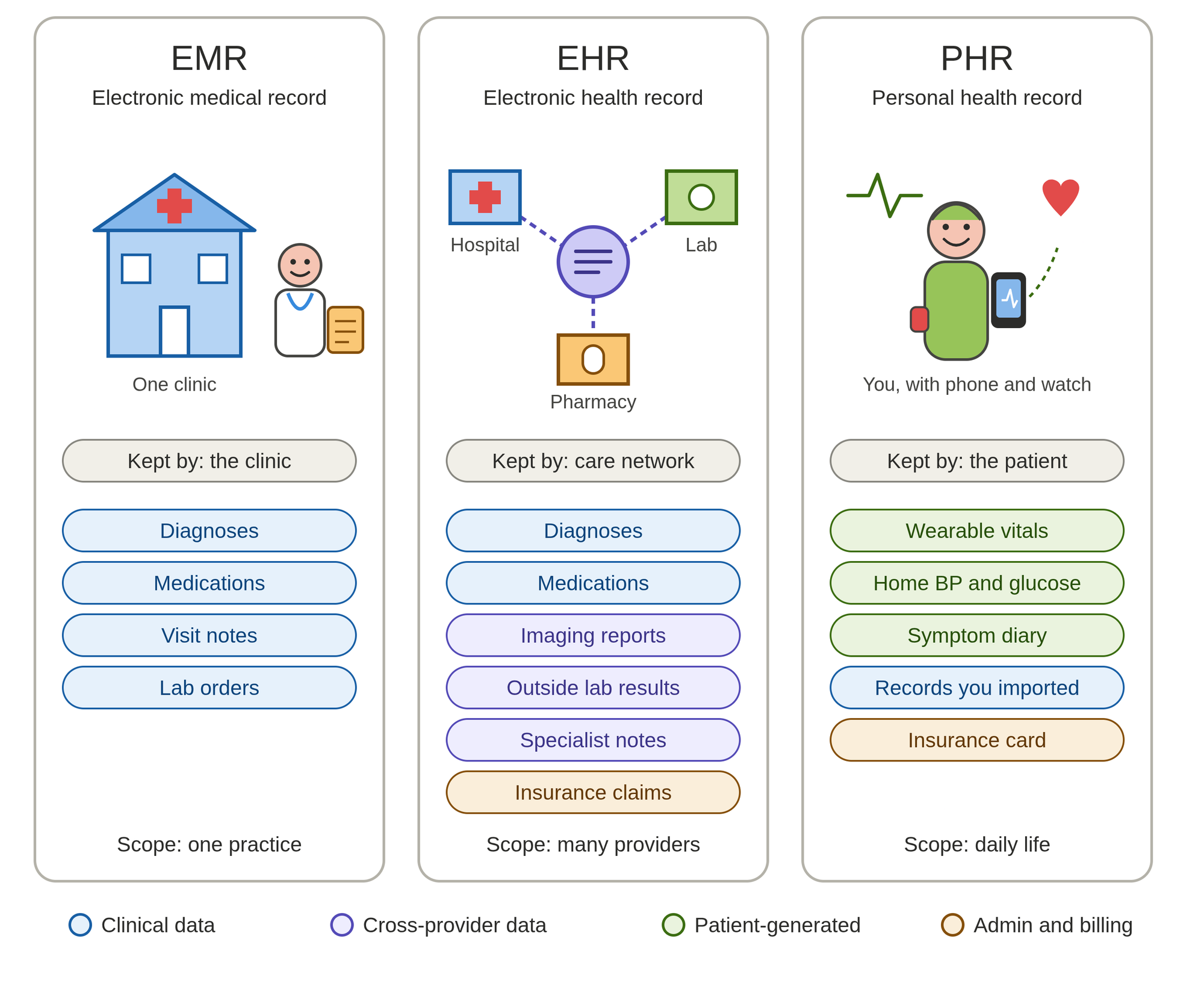
Before looking at how AI is being used, it is important to understand the difference between EHR, EMR and PHR.
An Electronic Medical Record (EMR) is primarily the digital version of a patient's medical chart within a particular healthcare provider or clinical environment. It can contain diagnoses, medications, clinical notes, laboratory results and treatment information.
An Electronic Health Record (EHR) is broader. It is designed to provide a more longitudinal view of a patient's health information and facilitate information exchange across different healthcare providers and care settings.
A Personal Health Record (PHR) puts more emphasis on the patient's access to and management of their own health information. Depending on the platform, this may include information from healthcare providers, medications, health measurements, wearable devices, home-monitoring systems and information entered directly by the patient.
These systems increasingly overlap.
A patient's healthcare journey may look something like:
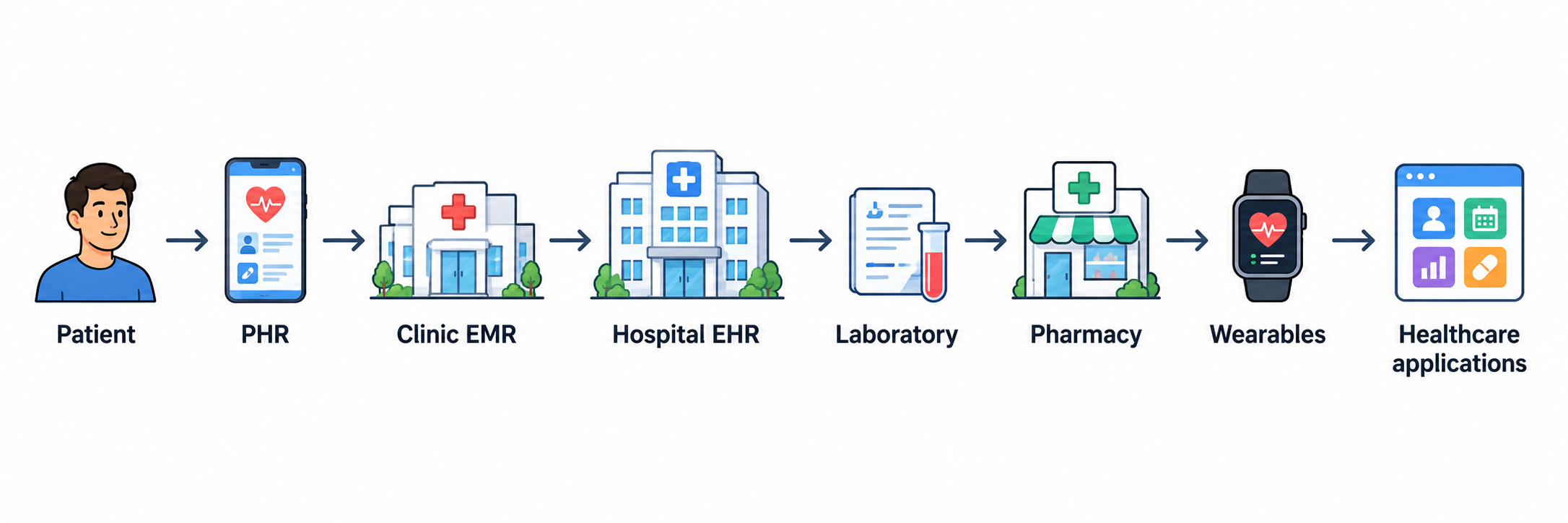
The opportunity for AI lies in making sense of information distributed across these different systems.
What Happens When EHR, EMR and PHR Data Are Connected?
Connecting healthcare data sounds straightforward until an organization actually tries to do it.
A hospital may have one EHR platform, a specialist clinic may use another EMR system, a laboratory may maintain its own database, and a patient may have health information stored in a mobile application or wearable device.
Bringing these sources together introduces a number of technical challenges.
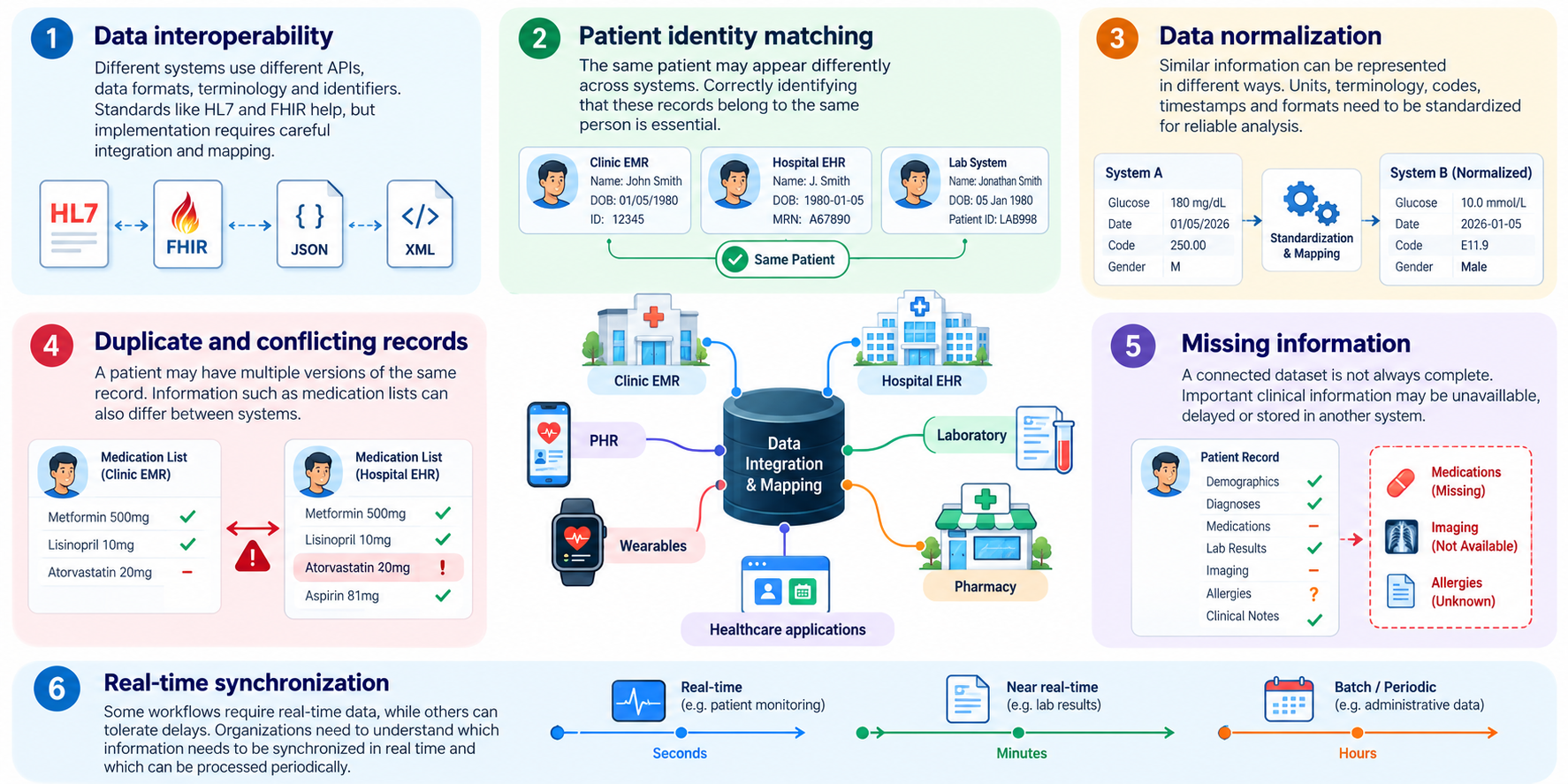
Data interoperability
Different systems may use different APIs, data formats, terminology and identifiers. Healthcare interoperability standards such as HL7 and FHIR can help systems exchange information, but implementation still requires careful integration and mapping.
Patient identity matching
The same patient may appear differently across different systems. One database might contain a full name and date of birth, while another uses a different identifier. Correctly determining that these records belong to the same person is essential.
Data normalization
Healthcare systems frequently represent similar information in different ways. Units, terminology, codes, timestamps and formats may need to be standardized before the information can be analyzed reliably.
Duplicate and conflicting records
A patient may have multiple versions of the same record. Medication lists may also differ between systems. One system might show an old prescription while another contains a newer update.
Missing information
A connected dataset does not automatically become a complete dataset. Important clinical information may still be unavailable, delayed or stored in another system.
Real-time synchronization
For some healthcare workflows, information that is several hours old may be useful. For others, stale information can create operational problems. Organizations therefore need to understand which information needs to move in real time and which can be processed periodically.
This is where healthcare data engineering becomes critical.
AI can analyze connected healthcare data, but the underlying infrastructure needs to establish where the data came from, whether it belongs to the correct patient, whether it is current and whether it can be trusted.
From Historical Healthcare Data to Predictive Intelligence
Traditional healthcare analytics often focuses on what has already happened.
How many patients were admitted?
How many appointments were missed?
What was the patient's previous diagnosis?
What were their previous laboratory results?
AI introduces the possibility of moving from descriptive analytics toward predictive intelligence.
By analyzing historical EHR and EMR data, machine-learning systems can identify patterns associated with outcomes such as:
- Hospital readmission
- Disease progression
- Patient deterioration
- Medication adherence
- Potential complications
- Missed appointments
- High-risk patient populations
For example, a healthcare organization could analyze historical records to identify combinations of clinical and operational factors that have historically been associated with higher readmission rates.
The resulting model could then provide a risk signal to the appropriate care team.
The important distinction is that a prediction should generally be treated as decision support, not as an unquestionable clinical decision.
Healthcare AI needs appropriate validation, monitoring and human oversight, particularly when its outputs can influence patient care.
The value of predictive AI therefore depends not only on the model but also on the quality and context of the data feeding it.
AI for Healthcare Administrative Data
Healthcare AI is often discussed in the context of diagnosis and clinical decision support. However, some of the most practical applications are administrative.
Healthcare organizations process enormous amounts of operational information related to:
- Claims
- Billing
- Prior authorization
- Referrals
- Appointment scheduling
- Insurance documentation
- Medical coding
- Patient communication
Many of these workflows involve repetitive document processing, information extraction, classification and communication.
AI can assist by extracting relevant information from documents, identifying missing information, categorizing requests, summarizing records and routing tasks to the appropriate team.
Consider prior authorization as an example.
A workflow may require information from a patient's clinical record, physician documentation, insurance requirements and supporting test results. Instead of requiring staff to manually search through multiple documents, AI can assist with finding and organizing relevant information.
The goal is not necessarily full automation.
In many cases, the better approach is human-assisted automation, where AI handles repetitive information-processing work while people retain responsibility for important decisions.
This also demonstrates why EHR and EMR data should not be viewed purely as clinical information. The same data can support significant operational improvements across the healthcare organization.
How Is the Healthcare Industry Unifying Its Data?
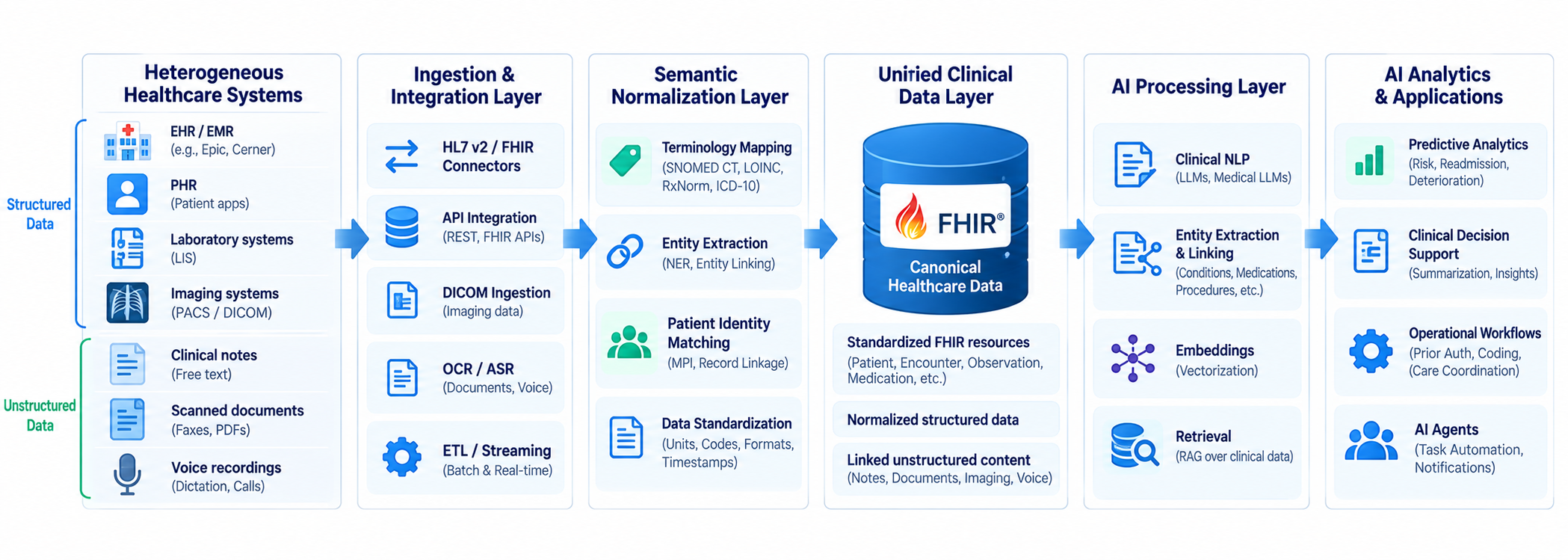
EHRs, EMRs, PHRs, laboratory information systems, PACS, pharmacy platforms, remote-monitoring devices and patient-facing applications collectively generate an enormous volume of healthcare data. The problem is that this information rarely arrives in a single, consistent representation. It is distributed across vendor-specific databases, APIs, messaging protocols, coding systems and document repositories.
A hospital may expose clinical data through HL7 v2 messages and FHIR APIs, while diagnostic imaging is managed through DICOM/PACS, laboratory information may reside in an LIS, and patient-generated information may arrive through mobile APIs or wearable-device platforms. On top of this structured data sits a large unstructured layer: clinical notes, scanned documents, PDFs, faxes, dictated notes, call transcripts and other free-text content.
Healthcare interoperability is therefore not simply a matter of connecting APIs. It is a data harmonization problem.
FHIR has become an important part of the modern interoperability stack because it provides standardized healthcare resources and API-based mechanisms for exchanging clinical and administrative information. The U.S. ONC describes FHIR as an API-focused standard for representing and exchanging health information, while HL7 defines FHIR around reusable resources and RESTful interfaces.
But a FHIR endpoint does not automatically mean that two systems understand the underlying information in the same way.
The convergence starts at the integration layer
A typical healthcare data architecture begins with an ingestion and integration layer.
This layer may contain:
- HL7 v2 interfaces
- FHIR REST APIs
- Bulk FHIR ingestion
- DICOM interfaces for medical imaging
- Vendor-specific APIs
- ETL/ELT pipelines
- Event streams and message queues
- OCR pipelines for scanned documents
- Automatic speech recognition (ASR) for voice data
The objective is to bring heterogeneous source data into a controlled processing environment without losing its provenance.
For production systems, this often means maintaining metadata such as source system, event timestamp, ingestion timestamp, patient identifier, encounter identifier, message type and data lineage alongside the clinical payload.
That distinction becomes important later when an AI system needs to determine not only what a piece of information says, but where it came from and how current it is.
Standardization is more than changing the data format
Once data has been ingested, the next problem is semantic normalization.
Two systems might both contain a glucose measurement, for example, but represent its unit, terminology, timestamp or clinical context differently.
Healthcare data pipelines therefore commonly use terminology services and mapping layers to normalize concepts across systems. Depending on the domain, this can involve standards and vocabularies such as SNOMED CT, LOINC, RxNorm and ICD-10.
The Security Risks of Connecting EHR, EMR and PHR Data
Connecting healthcare systems creates enormous potential value, but it can also expand the organization's attack surface.
A healthcare environment may include EHR platforms, EMR systems, APIs, cloud infrastructure, mobile applications, medical devices, third-party integrations and patient-facing applications.
Each connection needs to be appropriately secured.
Potential risks include:
- Unauthorized access
- Compromised credentials
- Vulnerable APIs
- Ransomware
- Insider access
- Data exfiltration
- Third-party security weaknesses
- Cloud misconfiguration
The challenge becomes even more complicated when AI is added to the architecture.
AI applications may need access to patient records, documents, databases or APIs. Organizations therefore need to carefully control what information an AI system can access and what actions it is permitted to perform.
Security cannot be treated as a final layer added after an AI system has been deployed.
It needs to be considered throughout the architecture:
Identity → Access → Data → APIs → Models → Applications → Monitoring
For healthcare organizations, this also means maintaining appropriate audit trails and being able to understand how sensitive information moves through the environment.
What Happens When Healthcare Data Is Exposed?
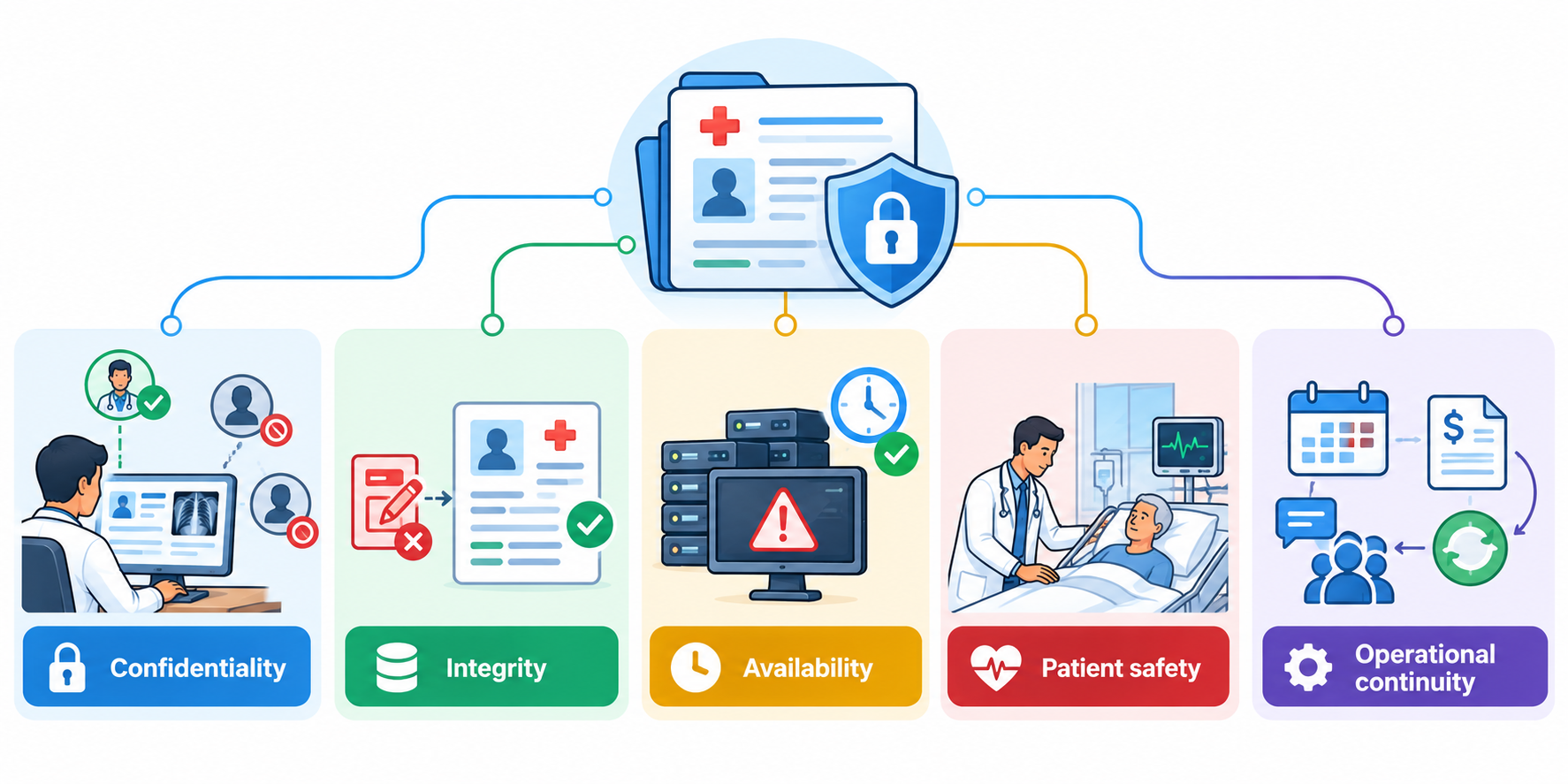
The consequences of healthcare data exposure can extend well beyond the loss of a database.
A compromised healthcare system could potentially expose diagnoses, medication histories, laboratory results, medical images, insurance information, personal identifiers, patient communications and other sensitive information.
But there are several dimensions to healthcare data security.
Confidentiality
Sensitive patient information should only be accessible to authorized individuals and systems.
Integrity
Healthcare information needs to remain accurate. Unauthorized modification of a medication, diagnosis or clinical record can be significantly different from simply exposing information.
Availability
Healthcare professionals may need access to patient information during time-sensitive situations. Ransomware or infrastructure failures can therefore create operational and potentially patient-care concerns.
Patient safety
When healthcare systems become unavailable or information cannot be trusted, clinical workflows can be disrupted.
Operational continuity
Healthcare organizations also depend on these systems for scheduling, billing, referrals, communications and other operational processes.
This is why healthcare cybersecurity cannot be reduced to protecting a database perimeter.
The entire data ecosystem needs appropriate security controls, monitoring and incident-response capabilities.
AI Agents and the Future of Healthcare Data Workflows
The next stage of healthcare AI may go beyond systems that simply answer questions.
AI agents could potentially coordinate carefully defined workflows across healthcare systems.
For example:
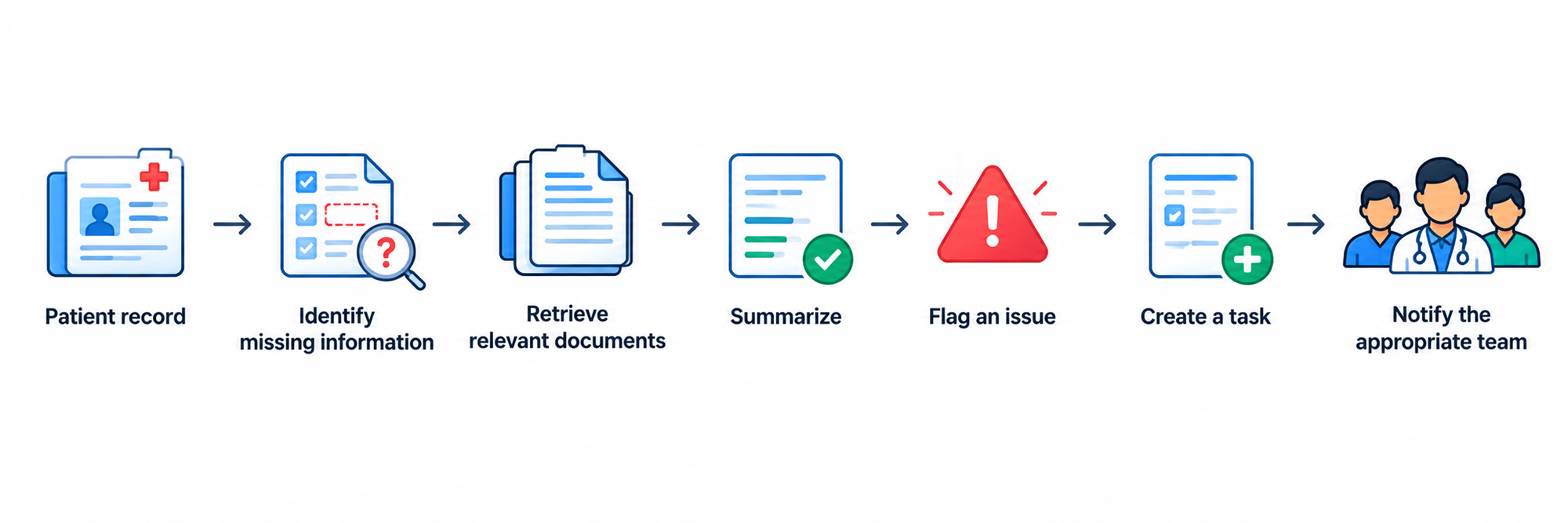
This workflow illustrates how AI can support a controlled healthcare data process. Starting with a patient record, an AI system can identify missing information, retrieve relevant documents, and summarize the available data. If it detects an issue or requires human attention, it can flag the finding, create an appropriate task, and notify the relevant healthcare team—helping reduce manual coordination while keeping people involved in the workflow. It can reduce the amount of manual coordination required for repetitive processes.
However, healthcare is not an environment where unrestricted automation is appropriate.
AI agents need clearly defined permissions and boundaries.
An agent that can read a patient record may not need permission to modify it. An agent that can create an administrative task may not need permission to make a clinical decision.
This makes concepts such as role-based access, approval workflows, auditability and human oversight particularly important.
The future of healthcare AI may therefore be less about completely autonomous systems and more about controlled AI-assisted workflows where people and AI systems each perform the tasks they are best suited to handle.
The Bigger Picture
As healthcare technology becomes more sophisticated, it is important not to lose sight of the fundamental objective.
The goal is not to introduce AI simply because AI is available!
The goal is to help healthcare professionals serve patients better.
That means technology should reduce unnecessary administrative work, improve access to relevant information and support better-informed decisions without creating additional friction for the people using it.
A new AI workflow should not force clinicians to abandon established processes unnecessarily. It should not create additional screens, duplicate data entry or confusing alerts that make routine work harder. It should not disrupt operational flows, interfere with established SOPs or introduce uncertainty into processes that healthcare professionals already rely upon.
Ideally, well-designed healthcare AI should fit into the existing environment.
The technology should work around the needs of the clinician, care team and patient—not expect the entire organization to reorganize itself around the technology.
This becomes particularly important as healthcare organizations connect more systems and introduce AI into increasingly sensitive workflows. Interoperability, privacy, security, transparency, human oversight and lifecycle monitoring all need to be considered alongside the technical capabilities of the AI system.
Several major international and national organizations publish guidance, standards or regulatory frameworks relevant to responsible AI and digital healthcare. These include:
1. World Health Organization (WHO)
The WHO has published dedicated guidance on the ethics and governance of AI for health, emphasizing human rights, accountability, safety, transparency and responsible use. Its more recent guidance also addresses large multi-modal AI models in healthcare.
2. U.S. Food and Drug Administration (FDA)
The FDA regulates medical devices, including AI-enabled medical devices, using a risk-based approach. Its AI resources cover areas such as good machine-learning practice, transparency, lifecycle management, monitoring and predetermined change-control plans.
3. International Medical Device Regulators Forum (IMDRF)
The IMDRF brings together medical-device regulators internationally and has developed guiding principles for Good Machine Learning Practice (GMLP). These principles are intended to support the development of safe, effective and high-quality AI/ML-enabled medical technologies throughout their lifecycle.
4. National Institute of Standards and Technology (NIST)
NIST's AI Risk Management Framework (AI RMF) provides a widely used framework for managing risks associated with AI systems. It addresses trustworthy AI considerations throughout design, development, deployment and evaluation. NIST also provides resources for operationalizing the framework.
5. European Commission
The European Commission's implementation of the EU AI Act provides a regulatory framework for AI systems operating in the European market, including requirements relevant to certain high-risk AI applications. The Commission is also developing guidance to help providers and deployers understand high-risk classifications and associated obligations.
These frameworks do not all serve the same purpose, and the requirements applicable to a particular healthcare AI system will depend on its intended use, jurisdiction, deployment model and whether it qualifies as a regulated medical device or another type of system.
For healthcare organizations operating across countries, this makes compliance-by-design and careful governance increasingly important.
The bigger principle, however, is straightforward:
Technology should make healthcare delivery better, not more complicated.
AI should help clinicians find information faster, help administrative teams process work more efficiently and help organizations understand their operations more clearly—while protecting patients and preserving the workflows that healthcare professionals depend on.
Why Healthcare Needs AIOps and Observability for AI
Deploying an AI model is only one part of building a healthcare AI system.
Once the system enters production, organizations need to understand whether the entire environment continues to operate correctly.
That can include monitoring:
- Data pipelines
- APIs
- EHR integrations
- Model performance
- Data quality
- Processing latency
- System errors
- Access patterns
- Cloud infrastructure
- AI outputs
- Overall system availability
For example, an AI model may appear to be functioning normally while an upstream EHR integration has stopped sending new laboratory information.
From the model's perspective, everything may look normal.
From the healthcare organization's perspective, the system is no longer operating with complete information.
This is why data observability and AIOps become increasingly important as AI becomes part of healthcare infrastructure.
Organizations need visibility across the complete chain:
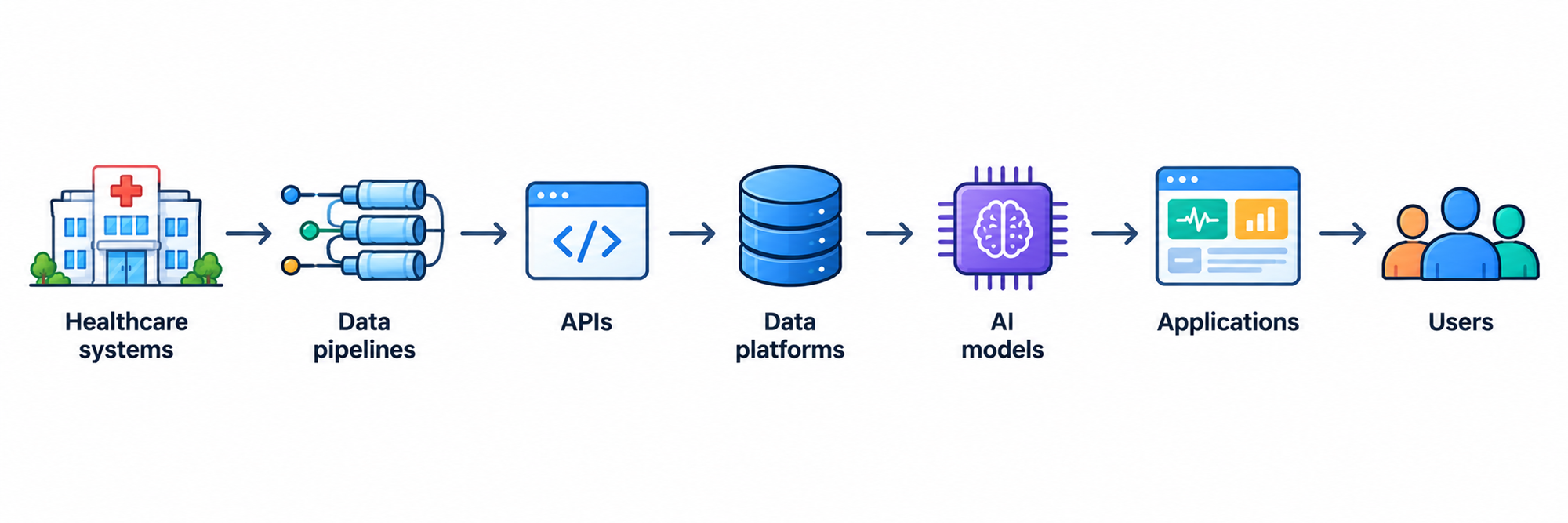
Monitoring only the final AI application is not enough.
Healthcare organizations need to understand what happened to the data before it reached the model, how the model behaved, and what happened after the output was generated.
Healthcare AI doesn't end when the model goes into production. That's when operational responsibility begins.
Building a Reliable Healthcare AI Data Foundation?
If you're exploring how to connect your healthcare data ecosystem or bring AI workflows into production, talk to Focused AiOps about your use case.
References
- World Health Organization (WHO) — Ethics and Governance of Artificial Intelligence for Health
WHO — Ethics and Governance of AI for Health - U.S. Food and Drug Administration (FDA) — Artificial Intelligence-Enabled Medical Devices
FDA — AI-Enabled Medical Devices - International Medical Device Regulators Forum (IMDRF) — Good Machine Learning Practice for Medical Device Development
IMDRF — Good Machine Learning Practice - National Institute of Standards and Technology (NIST) — AI Risk Management Framework
NIST — AI Risk Management Framework (AI RMF) - European Commission — EU Artificial Intelligence Act
European Commission — AI Act